online web builder


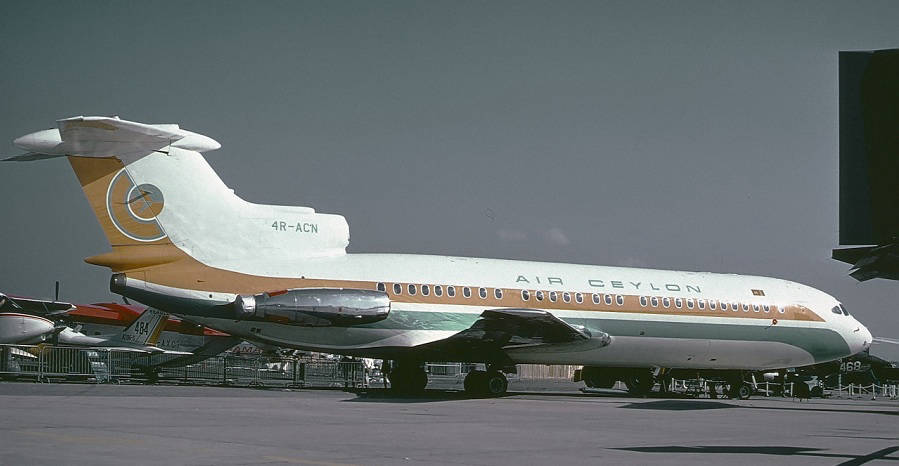
Air Ceylon
Hawker Siddeley

HS121 Trident


The Hawker Siddeley HS 121 Trident (alternatively the D.H.121) was a British short/medium-range three-engined jet airliner designed by de Havilland and built by Hawker Siddeley in the 1960s and 1970s. The Trident is notable for its pioneering avionics which enabled it to become the first airliner to make a fully automatic approach and landing in revenue service in 1965 and to be the sole airliner capable of automatic landings in regular service from 1966 until versions of the Lockheed TriStar were also cleared to perform them in the mid-1970s.

Designed very tightly around a British European Airways (BEA) specification, the Trident had modest sales, with 117 produced. The political and industrial aspects of its emergence, development, production, operation, and marketing were highly controversial in the 1960s and 1970s. Commentators have felt that the sales prospects and commercial usefulness of the type were gravely compromised because undue attention was paid to the needs of its launch customer who first insisted that it should be made much smaller than originally envisaged and who then insisted that it should be enlarged practically beyond the limits of its airframe and powerplant.

BEA's successor, British Airways retired the type in the early-mid 1980s. In China the Trident remained active in Air China service until the 1990s.

3 × Rolls-Royce RB.163-25 Spey 512 , 11,930 lbf (53.1 kN) each

Maximum speed: 590 mph
Cruise speed: 580 mph
Range: 2,700 miles (4,345 km)
Service ceiling: 27,000 to 36,000 ft (8,000 to 11,000 m)

Empty weight: 73,800 lb (33,475 kg)
Max takeoff weight: 142,500 lb (64,636 kg)

Length: 114 ft 9 in (35 m)
Wingspan: 98 ft (28.9 m)
Height: 27 ft (8.3 m)
Wing area: 1,462 sq ft (135.82 sq m)

Flight crew of three.

Capacity: 115 passengers.


Air Ceylon Aircraft Index

alkva

It was 1977 and we were on an old DC8 Air Ceylon coming in to Colombo, Ceylon from Bangkok. The landing approach was pretty bumpy, but the biggest bump was saved for when we hit the tarmac — a massive shudder and shake — at least I hoped it was the runway. We were soon however airborne again and climbing steeply when a voice with a heavy Indian accent came over the PA:

"I am sorry about the landing ladies and gentlemen, the pilot will now take over."

Tim Stuart, Great Aviation Quotes reader.

© ALKVA MMXI - MMXXII