best html templates


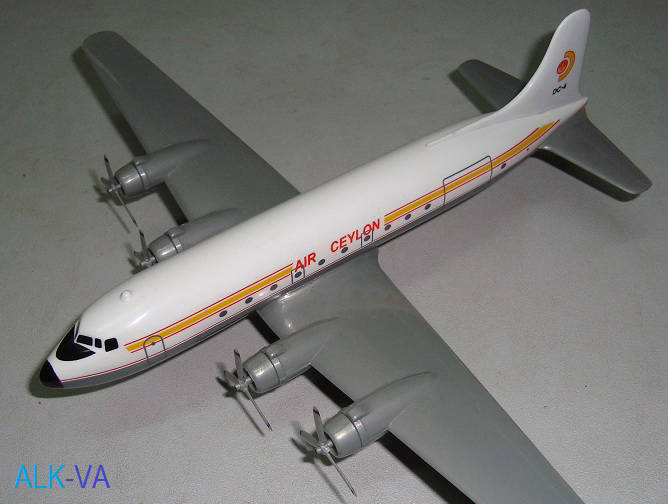
Air Ceylon
Douglas
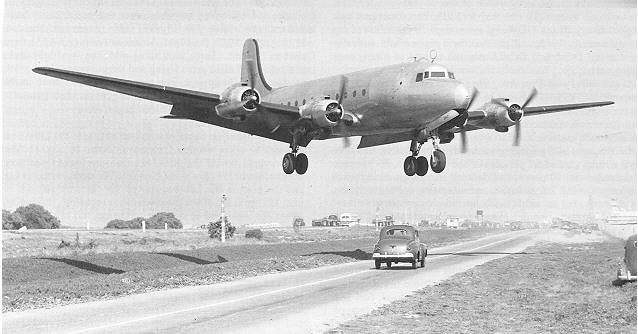
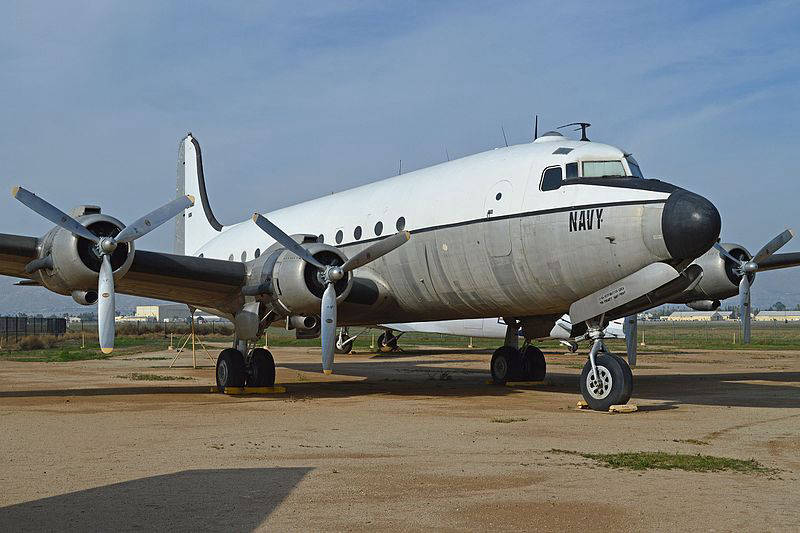
DC-4 Skymaster


The history of the DC-4 dates back to when United Airlines devised a requirement for a four engine long range airliner.

United looked to Douglas to fulfill the requirement, who devised the highly ambitious DC-4E (where the E stood for experimental). This four engined behemoth was flight tested in 1939. It was roughly three times the size of the DC-3 (its wingspan was 42.17m/138ft 3in, and length 29.76m/97ft 7in), had triple tail surfaces, tricycle undercarriage, was pressurised and potentially could fly nonstop from Chicago to San Francisco.

However all the ground breaking new technology on the DC-4E meant that it was costly, complex and had higher than anticipated operating costs, so Douglas thoroughly revised the design, resulting in the smaller and simpler definitive DC-4.

The new DC-4 was developed under the darkening clouds of WW2, and upon the USA's entry into war all DC-4s then on the production line were requisitioned for the US military. The result was that the first DC-4 flew for the first time on February 14 1942 in military markings (as the C-54 Skymaster). The DC-4 was found to admirably suit the USAAF's requirement for a long range cargo transport, and 1162 were built through the war years.

As was the case with the DC-3, the end of war meant that much of that number were surplus and sold to the world's airlines. Further to this Douglas built an additional 78 DC-4s to new orders. Over the years the survivors have been passed down to charter and freight airlines, and today small numbers survive in service as freighters.

Notable developments of the DC-4 include Aviation Trader's much modified Carvair freighter (described separately) while Canadair built a number with Rolls Royce Merlin engines and pressurised fuselages. The DC-4 also formed the basis for the larger DC-6 and DC-7 which are described separately (the DC-4 was the first airliner to introduce a circular section, constant diameter fuselage which made stretching the basic aircraft relatively simple).

Total DC-4 production comprised one DC-4E, 78 commercial DC-4s, 1162 military C54 Skymasters and 42 Canadair developed Merlin powered derivatives.

Four 1080kW (1450shp) Pratt & Whitney R20002SDBG Twin Wasp 14 cylinder twin row radial piston engines driving three blade constant speed propellers.

Max speed 451km/h (244kt), cruising speed 365km/h (197kt). Service ceiling 22,300ft. Range with a 5200kg (11,440lb) payload 4023km (2172nm).

Empty 19,460kg (43,300lb), max takeoff 33,112kg (73,000lb).

Wing span 35.81m (117ft 6in), length 28.60m (93ft 10in), height 8.38m (27ft 6in). Wing area 135.6m2 (1460sq ft).

Flight crew of two.

Standard passenger seating for 44, max seating for 86. Most surviving aircraft configured as freighters.

Mobirise


Douglas C-54A-DO c/n 3077-19 of Air Ceylon VP-CBE

Air Ceylon international services commenced in 1949 and were operated in partnership with Australian National Airways using two DC-4s, VP-CBD and VP-CBE. In 1950 these were re-registered CY-ACA and CY-ACB respectively.

An illustration which appeared in a 1949 magazine advertising Air Ceylon as 'The Trunk Route of the Orient'. The DC-4s were flying into London Heathrow at the time and shows 'Ratmalana' in profile as VP-CBE. In December 1950 this DC-4 joined ANA.


Australian National Airways applied for an Australian C of R for a DC-4 - November 25, 1948
Entered onto the Australian Aircraft Register as VH-ANF (c/n 3077) - November 25, 1948
This Certificate of Registration was not taken up
Transferred to Air Ceylon - January 21, 1949
Entered onto the Ceylonese Aircraft Register as VP-CBE - January 24, 1949
Departed London (Heathrow) on delivery flight to Melbourne - January 21, 1949
Cancelled from the U.S. Aircraft Register - January 24, 1949
Arrived Melbourne's Essendon Airport at conclusion of delivery flight - January 26, 1949
Delivery route: London-Castel Benito-Cairo-Karachi-Colombo-Singapore-Darwin-Melbourne
Operated first Air Ceylon revenue service Melbourne-London - February 4, 1949
Aircraft was named by the Governor-General of Ceylon 'Ratmalana' - February 7, 1949
Reregistered CY-ACB - October 11, 1950
Sold to Australian National Airways Pty Ltd - December 1950
Entered onto the Australian Aircraft register as VH-INZ - December 21, 1950
Aircraft retained the name 'Ratmalana' (site of Colombo's first airport)
Remained under charter to Air Ceylon and operated in full Air Ceylon livery
Returned to A.N.A. when Air Ceylon ceased operations - July 23, 1953

Air Ceylon Aircraft Index

alkva

> In the ongoing battle between objects made of aluminum going hundreds of miles per hour and the ground going zero miles per hour, the ground has yet to lose.

> In flying, you need at least two of these three to stay alive: altitude, speed or brains.

> If you’re ever faced with a forced landing at night, turn on the landing lights to see the landing area. If you don’t like what you see, turn’ em back off.

> If an airplane is still in one piece, don’t cheat on it; ride the bastard down. – Ernest K. Gann

© ALKVA MMXI - MMXXII