develop own website


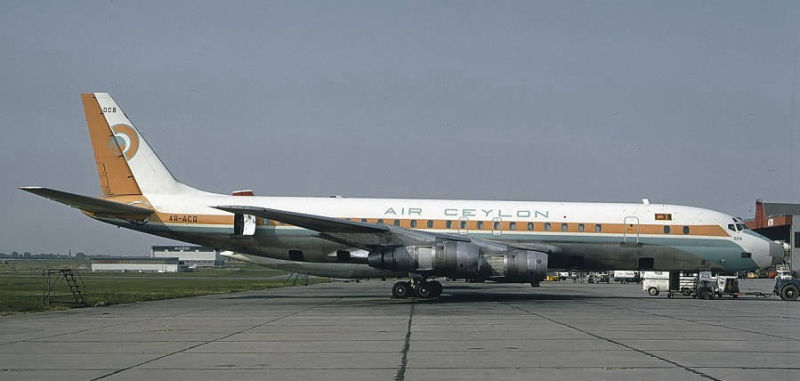
Air Ceylon
Douglas

DC-8


The popular DC-8 was Douglas' first jet powered airliner, and the USA's second successful jet powered transport behind the Boeing 707.

Despite its strong hold on the world airliner market in the early 1950s, and the appearance of the jet powered De Havilland Comet in 1949, Douglas moved cautiously into the field of jet powered transports, a decision which was to cost it dearly in lost potential sales over the following decades.

Douglas announced it was developing the jet powered DC-8 airliner in June 1955, a year after the first flight of the Boeing Model 367-80, the 707 predecessor. The first DC-8 flew on May 30 1958, five months before the 707 entered service with Pan Am. A concerted flight test program involving nine aircraft led to certification being awarded on August 31 1959. Entry into commercial service with launch customers United and Delta was on September 18 that year.

Unfortunately for Douglas, the earlier availability of the 707 meant that initial sales of the DC-8 were relatively slow. However, the emergence of Douglas' design had already forced Boeing to widen the fuselage width of the 707, and unlike the Boeing the DC-8 was offered in domestic and intercontinental versions from the start.

Versions of the initial short fuselage DC-8 were: the Series 10, the initial domestic version with 60.1kN (13,500lb) P&W JT3C-6 turbojets - 28 were built for Delta and United; the similar Series 20 but with more powerful 74.7kN (16,800lb) JT4A-9 turbojets; the intercontinental Series 30 and Series 40, powered by JT4A-11s or Rolls-Royce Conways respectively; and the Series 50, perhaps the definitive short fuselage model and a direct competitor to the 707-320B/C, with 80.1kN (18,000lb) JT3D-3 turbofans. Convertible 50CF and pure freight 50AF Jet Trader versions were also offered, while others were subsequently converted to freighters.

The short fuselage DC-8s were replaced in production by the substantially larger stretched DC-8 Super Sixty series.

295 Series 10, 20, 30, 40 and 50 DC-8s built between the late 1950s and 1968.

Series 50 - Four 80.1kN (18,000lb) Pratt & Whitney JT3D-3 turbofans.

Series 50 - Max cruising speed 933km/h (504kt). Range with max payload 9205km (4970nm), max range 11,260km (6078nm).

Series 50 - Operating empty 60,020kg (132,325lb), max takeoff 147,415kg (325,000lb).

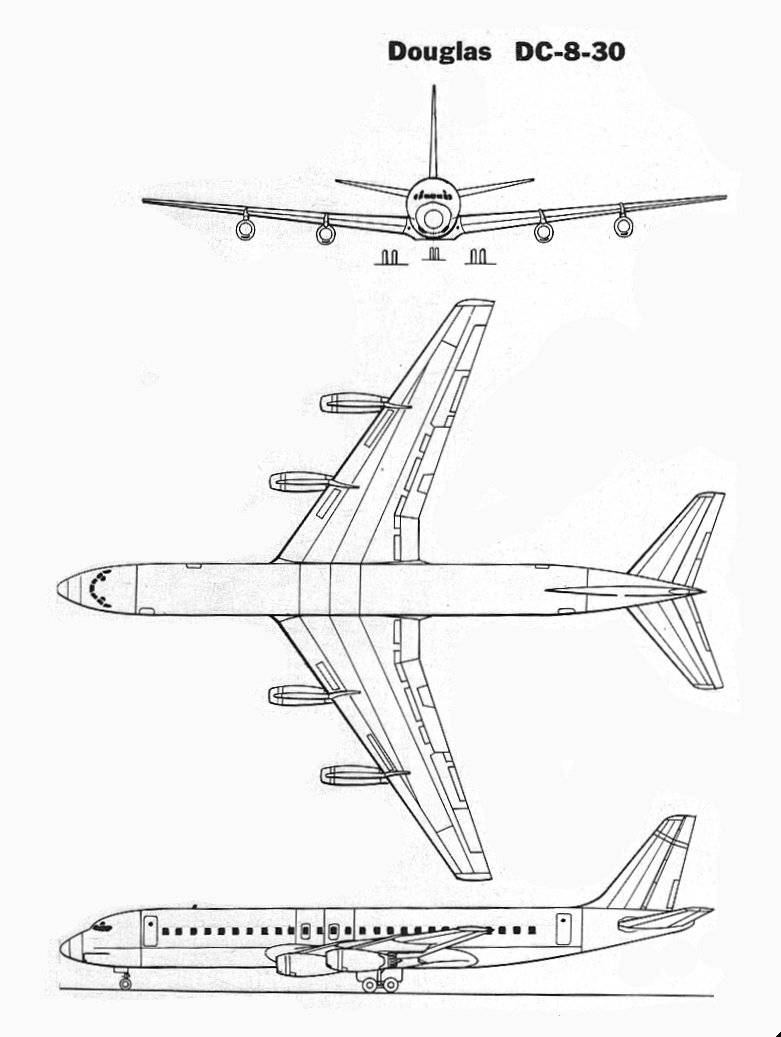
Wing span 43.41m (142ft 5in), length 45.87m (150ft 6in), height 12.91m (42ft 4in). Wing area 257.6m2 (2773sq ft) on early aircraft, 266.5m2 (2868sq ft) on later aircraft.

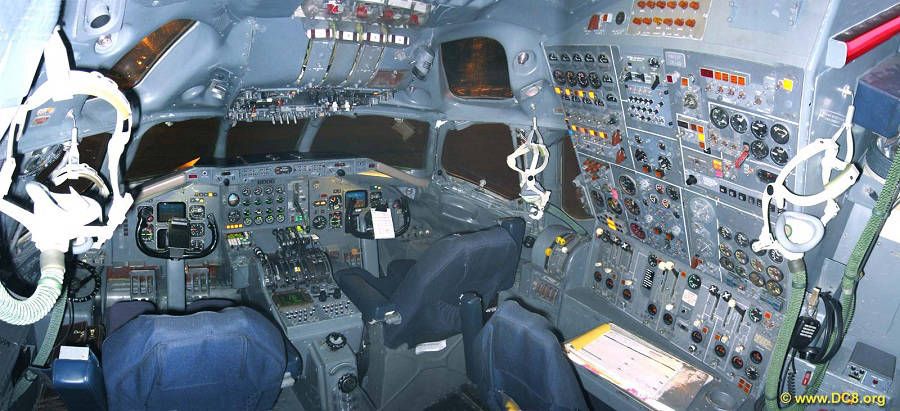
Flight crew of three.

Mixed class seating for 132, typical all economy seating for 144, or up to 179 in high density single class layout. A number of aircraft are converted for VIP/executive use. Freighter versions can carry approximately 15 tonnes (34,000lb) of cargo consisting of pallets or containers.


1. Pomair DC-8 was ex Pan Am and was leased to Air Ceylon

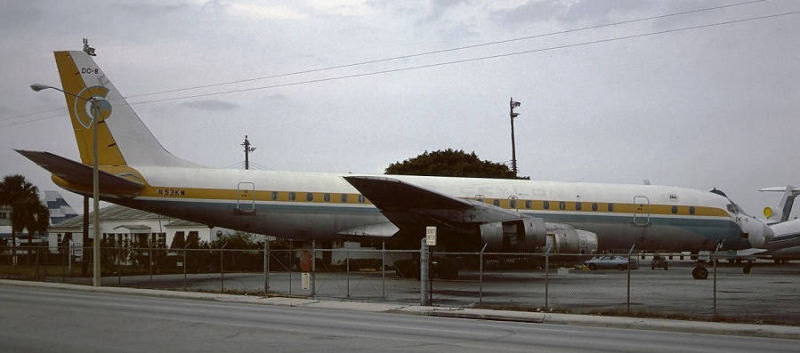
2. Ex Air Ceylon DC-8-53 at Miami - International (MIA / KMIA), USA - Florida, May 1979

Air Ceylon Aircraft Index

alkva

You know they invented wheelbarrows to teach FAA inspectors to walk on their hind legs. - Marty Caidin 

The light at the end of the tunnel is another airplanes landing light coming down head-on to the runway you are taking off from. - Robert Livingston, Flying The Aeronca.

Newton’s Law states that what goes up, must come down. Our Company Commander’s Law states that what goes up and comes down had damn well better be able to go back up again. - Sign in the Operations Office of the 187th Assault Helicopter Company, Tay Ninh, Viet Nam, 1971.

© ALKVA MMXI - MMXXII